


The niche vs designer perfume debate is about far more than price. It comes down to who makes the fragrance, who it is made for and how it reaches you. Once you understand the four main categories (designer, niche, artisan and independent), you can skip years of blind buying and put your money into a scent that genuinely deserves it. Below we explain each category in plain language, compare them side by side, show where Arabian oud houses fit, and help you decide what belongs on your shelf.
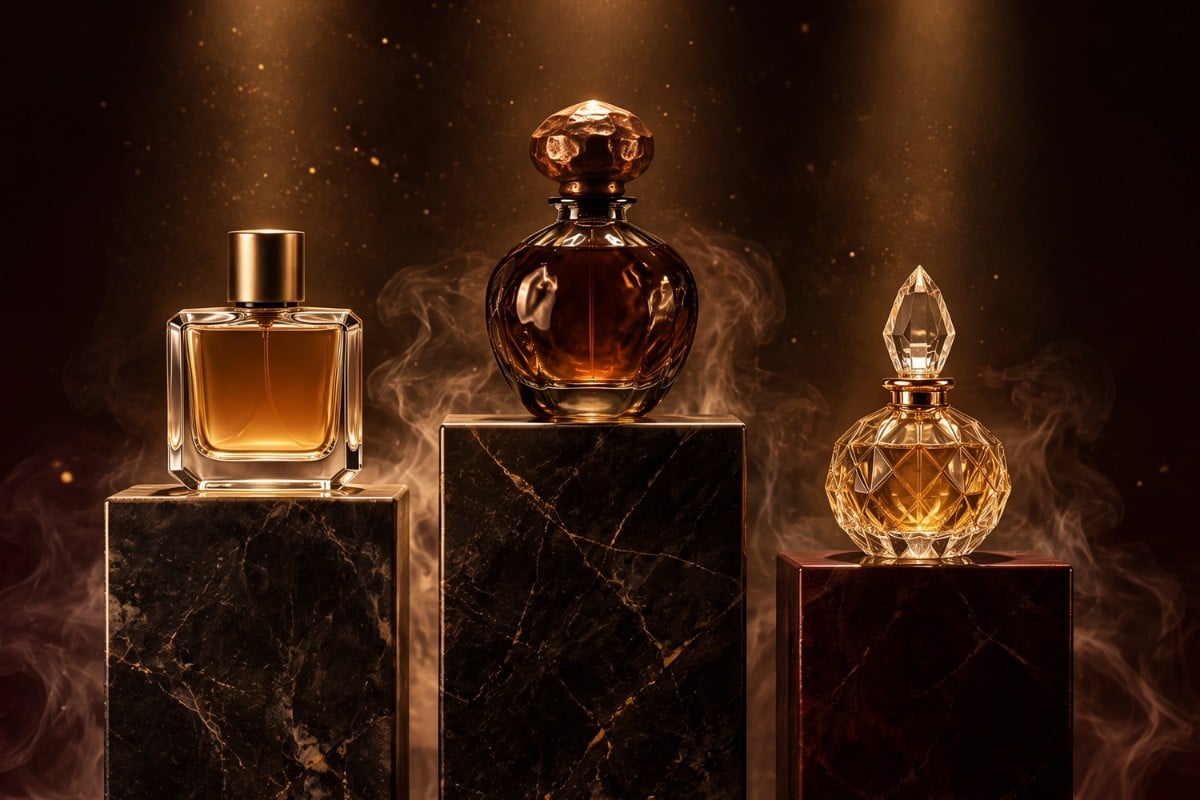
Glass perfume bottles with golden caps, each from a different school of perfumery — Source: Pexels
◈ Designer fragrances: the safe crowd-pleaser
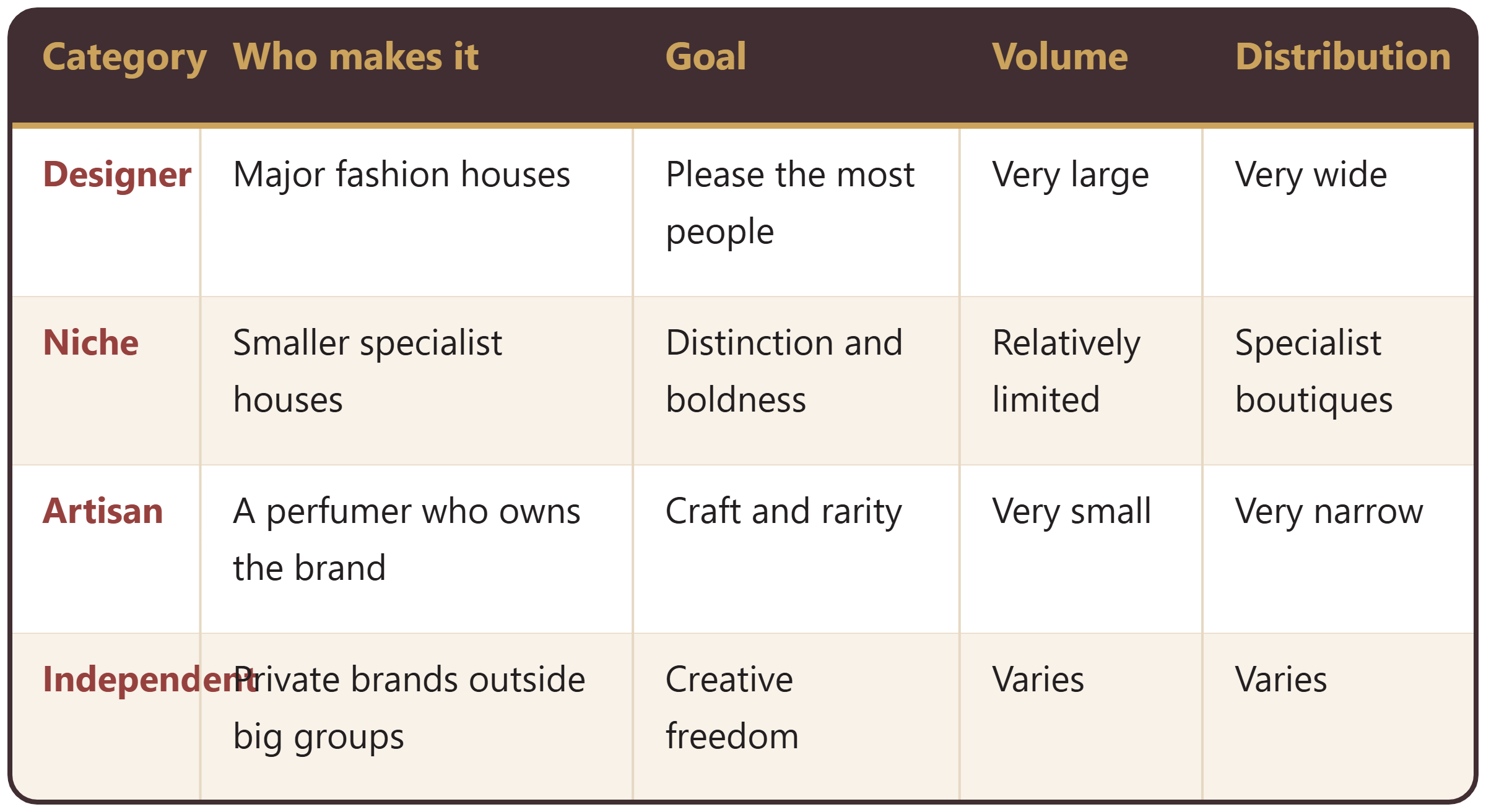
Designer fragrances are released by fashion houses and big-name brands. They come with large development and advertising budgets and are often tested on broad consumer panels before launch, because the goal is to appeal to as many people as possible.
The upside, therefore, is reliability. They are easy to wear, available everywhere and well suited to the office. However, the downside is familiarity: you may sit in a meeting with three other people wearing exactly the same scent.
◈ Niche perfumes: boldness and a personal signature
Niche perfumes come from smaller, specialist fragrance houses that give perfumers more room to experiment. They do not try to please everyone. Instead, they speak to people looking for a scent with character. Batches are relatively limited, distribution runs mainly through specialist boutiques, and many are made at higher concentrations.
◈ Artisan and independent perfumes: the perfumer's hand
Artisan perfumes are made by a perfumer who owns the brand and oversees every stage by hand. Quantities are tiny and the time invested is considerable.
Independent (indie) perfumes, by contrast, come from privately owned brands outside the large beauty groups. An indie brand may also be niche or artisan; what unites them is creative freedom.
◈ Niche vs designer perfume: the comparison table
◈ Why the lines have blurred
In recent years big groups have bought well-known niche brands. Estée Lauder, for example, acquired Le Labo and Frédéric Malle in 2014. As a result, some fragrances now carry a niche spirit while being run with big-group thinking.
So the niche vs designer perfume line today is less a wall than a spectrum. Three facts help you read it:
- One fragrance can be niche and independent at the same time.
- "Artisan" signals time and care, but does not guarantee quality on its own.
- A category describes how a perfume is made and sold, not how good it smells.
◈ Where do Arabian oud houses fit?
Many Arabian perfume and oud houses combine all three qualities: independent ownership, specialisation in particular raw materials such as oud, rose and ambergris, and reliance on hand craft in blending and ageing. An oil distilled from carefully chosen wood and then left to age for years is pure craft; no factory line can rush it.
That is why global niche enthusiasts increasingly find what they want in Arabian perfumery: authentic materials, real depth and a true story behind each bottle. In the Gulf we have always known this. Oud in the majlis was never a mass-market product.
◈ Henry Jacques: a living example of artisan perfumery
If you want one house that shows niche and artisan values together, look at Henry Jacques. Perfumer Henry Jacques Cremona founded his namesake house in 1975, as its brand page at Harrods notes. He built it with his wife Yvette, and the house sits near Grasse, the French capital of perfume.
Today the family still runs it, led by his daughter Anne-Lise Cremona, as the South China Morning Post reports. The house does not chase advertising. Instead, it makes concentrated perfume oils in small quantities for clients who know exactly what they want.
At Thulaim Oud you can find a rare piece from this house: a perfume oil formulated for the late Sultan Qaboos, from his own collection, and never sold in boutiques.
◈ How to read a perfume label before you buy
A label tells you more than you might think, once you know what to look for:
- Concentration: eau de toilette is lightest, then eau de parfum, then extrait, then pure perfume oil, the most concentrated of all.
- The house: is it a fashion house or a specialist fragrance house?
- Origin and key materials: especially when oud or Taif rose is named.
- Size: small formats often signal a perfume measured in drops rather than sprays.
The higher the concentration, the fewer applications you need and the longer the scent lasts, which often makes a concentrated perfume better value over time despite a higher price.
◈ Which should you choose? A quick guide
- A dependable office scent: a designer fragrance is a practical choice.
- A signature people remember in the majlis: niche or artisan.
- A luxury gift that will not be duplicated: a high-concentration niche perfume or a natural oud oil.
- Authentic Arabian character: natural oud, oud oils and blends, which are niche in their own right.
Understanding niche vs designer perfume does not mean choosing one side forever. Many connoisseurs keep a simple everyday designer scent and a niche fragrance for special occasions.
◈ Is a niche perfume worth the price difference?
This is the question most buyers really care about. The honest answer: it is worth it when you are paying for something you can actually feel. Ask yourself:
- Does it last longer? A concentrated scent that carries you through the evening can be better value than a light one you reapply three times.
- Does it set you apart? If you want a signature people remember, limited production has value in itself.
- Does it suit your rituals? If you perfume your clothes with bakhoor and wear dehn al oud before going out, you need a fragrance that layers with them rather than clashing.
- Are the materials stated clearly? A house that names its raw materials and origins with confidence deserves more trust than one selling a story alone.
If the answers are yes, the extra cost is not a premium for a label; it is the price of a scent that stays with you for years.
◈ Mistakes people make when comparing
- Judging a perfume by the name of the house rather than how it smells on your skin.
- Assuming every expensive perfume is niche, and every niche perfume is the best.
- Ignoring concentration when comparing prices; a small concentrated bottle can outlast a large light one.
◈ Suggested Thulaim Oud products
- Thulaim 00002 Perfume — a scent from our own collection that captures the niche spirit: a chosen signature in limited quantity.
- Henry Jacques Perfume — a concentrated perfume oil (3 ml, quarter tola) from the collection of the late Sultan Qaboos, formulated for him and never sold in boutiques. It opens soft and powdery, then settles into warm woody depth, and two drops last a full day. Order yours today.
◈ FAQ
What is the difference in niche vs designer perfume, in short?
Designer perfumes are created to please the majority and sold everywhere; niche perfumes are made in smaller quantities with bolder compositions for people seeking distinction.
Are designer perfumes lower quality?
Not necessarily. Some are timeless classics, but they are designed to suit the widest audience.
What is an artisan perfume?
A fragrance made by a perfumer who owns the brand and personally oversees its composition, in very small quantities.
What is the highest perfume concentration?
Pure perfume oil and extrait, followed by eau de parfum and then eau de toilette.
Is oud oil an artisan product?
Usually, yes. Selecting the wood, distilling and ageing all depend on human expertise and time.
At Thulaim Oud (عود ثليم) we offer what unites craft and rarity: hand-selected perfumes and oils, described honestly. The store is also verified on the Saudi Business Platform, and every product page shows a full refund guarantee. Enjoy fast free shipping across Saudi Arabia and same-day delivery in Riyadh. Finally, use the code "Thulaim" for 10% off your first order, with easy instalments via Tabby and Tamara.