

Oud oil, known in Arabic as dehn al oud, is the aromatic oil distilled from resin-saturated agarwood, and perfumers have long called it "liquid gold". In the Gulf, a single dot behind the ear before prayer or the majlis is a habit handed down through generations. Yet few people know how far that drop has travelled: from a tree in an Asian forest, through days in a still, into the small bottle in your hand. This guide explains what it is, how it is made, why it is sold by the tola, and how to tell the real thing.
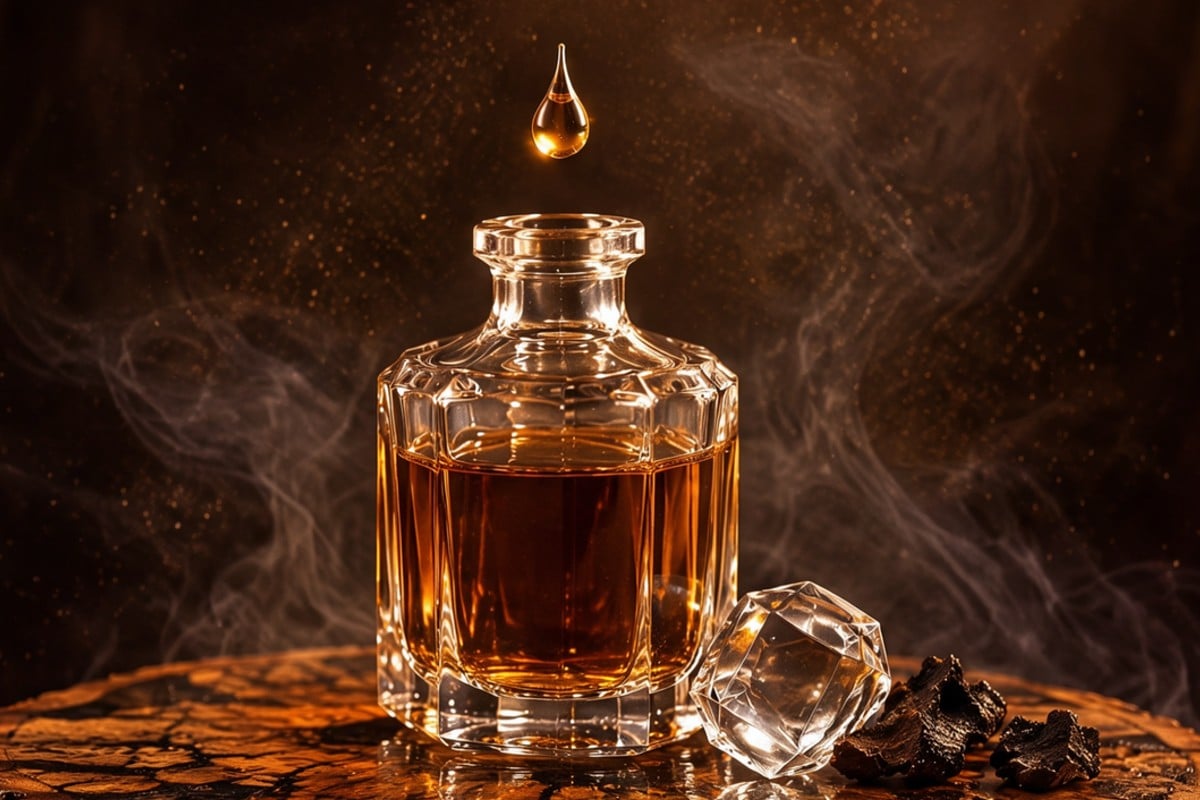
Traditional bottles hold the most precious part of the agarwood tree — Source: Pexels
◈ Where it begins: the story of the resin
It all starts with Aquilaria trees in South and Southeast Asia. At first, healthy Aquilaria wood is pale, light and almost scentless. When the tree is wounded or infected by a fungus, it defends itself by producing a dark, fragrant resin. Over years the wood becomes saturated with it and turns into agarwood, or oud. In short, that resin is the source of every note you smell; the deeper and older the saturation, the richer the oil.
◈ How oud oil is distilled, step by step
- Sorting: resin-rich wood is separated from pale wood with little aromatic value.
- Chipping or grinding: the wood is broken into small pieces or powder so its oil can be released.
- Soaking: the wood soaks in water before distillation. How long is one of each distiller's closely held secrets.
- Distillation: it is water- or steam-distilled for many hours, sometimes days; modern extraction methods are also used today.
- Separation and resting: the oil floats on the water, is gathered carefully and left to settle before bottling.
Every step leaves a fingerprint, which is why two oils from the same origin can smell completely different.
◈ Why is it so expensive?
The numbers explain it. For example, the Wikipedia entry on agarwood notes that 70 kg of wood may yield no more than 20 ml of oil. Add the rarity of naturally resinated wood, the long distillation and a distiller's experience that cannot be bought. Meanwhile, AramcoWorld reported that a quarter-tola bottle of good oil can exceed US$300, yet it can last its owner around a year, because a single dot carries you through a whole day.
◈ What is a tola?
The tola is a traditional unit of weight of roughly 12 g, still used across the Gulf's oil trade. Fine oils are usually sold by the quarter tola, which many stores describe as about 3 ml. If you are used to 100 ml perfume bottles, that sounds tiny. However, with a concentrated oil, it is generous.
◈ What is inside pure oud oil?
More than 150 aromatic compounds, chiefly sesquiterpenes and chromones. That chemical complexity creates a depth that is very hard to copy synthetically, and it explains why the scent evolves on skin: an opening, then a different heart an hour later, then a warm base that lingers into the evening.
◈ What makes one oil better than another?
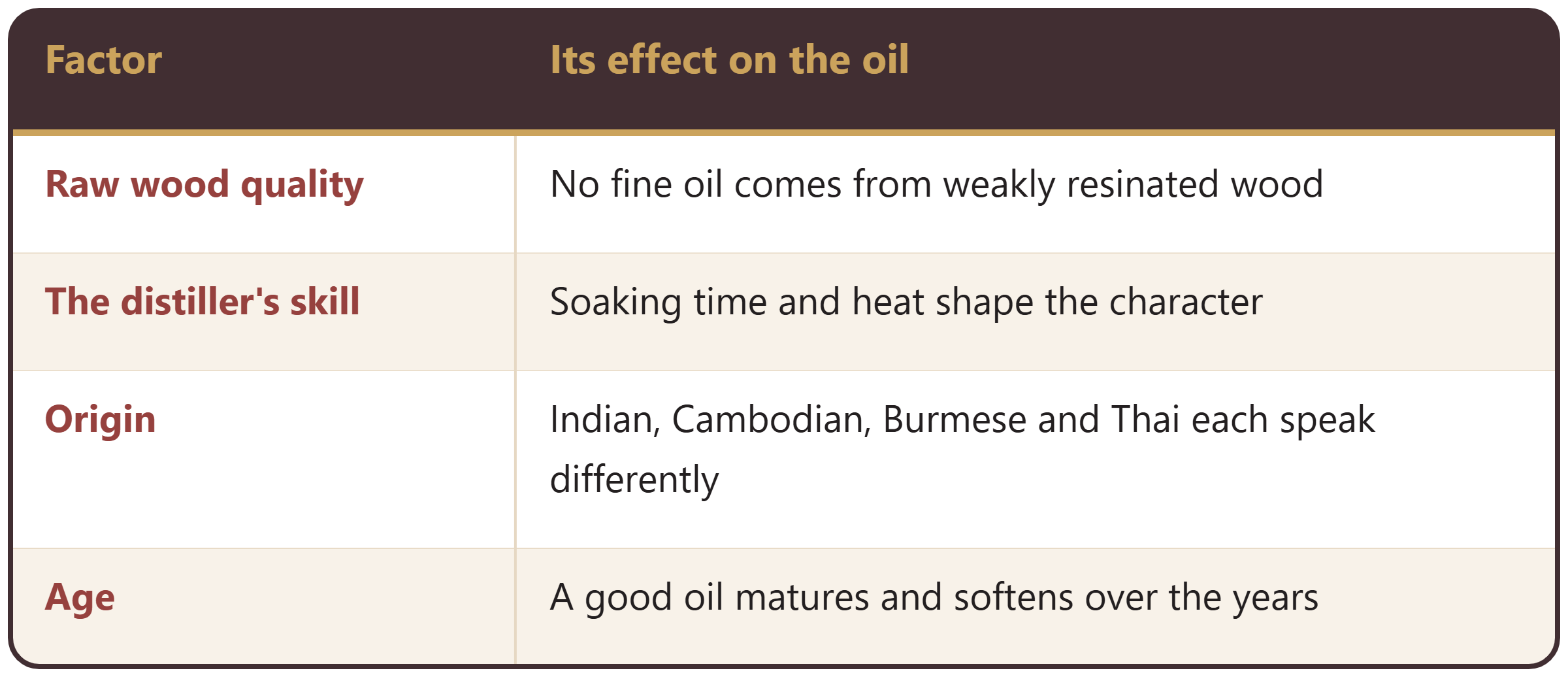
A common mistake is judging by thickness. In fact, viscosity alone says little about quality; a lighter oil can be cleaner and more refined than a heavy one.
◈ Origin signatures: India, Thailand and beyond
Above all, each origin has its own accent. Indian oils are known for depth, strength and a warm, animalic edge that seasoned collectors love. Thai oils, including those from Trat province near the Cambodian border, are generally valued for balance and a smoother profile. Cambodian oils lean sweet, while Burmese oils have their own distinct style. There is no single "best" origin, only the one that suits your taste and the occasion.
◈ From the majlis to global perfume houses
Dehn al oud is no longer only an Eastern treasure. In recent decades it has become one of the most sought-after materials in global perfumery, and the word "oud" now appears on bottles sold in every major city. Yet the truly rare, undiluted oils still tend to find their way to their first admirers in the Gulf, where pure oil is valued exactly as it is.
◈ Pure oil or a perfume "with oud"?
A spray labelled "oud" may contain only a small share of natural oud, or a synthetic substitute, diluted in alcohol. By contrast, pure oud oil is oud itself in its most concentrated form, with no alcohol and no water. That is why it sits closer to the skin, lasts longer and evolves more richly. Many enthusiasts combine the two: the oil as a base on skin, a light spray on top.
◈ How to spot an authentic oil when buying
- Buy from a store that states origin, type and volume for each oil.
- Dab a dot on your wrist and wait a few hours. Real oil evolves; imitations stay flat, then fade.
- Be wary of very low prices on oils described as "aged" or "rare".
- Read reviews that mention longevity and development, not just the bottle.
That is why Thulaim Oud lists the type, origin and volume on every oil's page, so you can compare with confidence.
◈ Storing your oil so it lasts for years
Keep the bottle tightly closed, away from sunlight and heat, ideally in a drawer or wooden box. Good natural oil does not spoil easily; many oils actually grow smoother with time, which is why some collectors set a bottle aside for years before opening it.
◈ Suggested Thulaim Oud products
- Luxurious Indian Oud Oil — the ideal introduction to the deep Indian character on which oud's reputation was built.
- Aged Trat Oud Oil — an aged Thai oil for anyone curious to experience what time does to dehn al oud.
◈ FAQ
What is oud oil in simple terms?
It is the aromatic oil distilled from resin-saturated Aquilaria wood, worn directly on skin and clothes and used as a base in luxury perfumery.
Does natural oud oil contain alcohol?
No. It is a pure distilled oil with no alcohol and no water.
How long does a quarter tola last?
With one dot a day it can last many months; AramcoWorld notes that about 3 g can last roughly a year.
Is the most expensive oil always the best?
Not necessarily. Price reflects rarity, age and origin, but the best oil for you is the one that suits your taste and occasion.
Does oud oil change over time?
Yes. Well-stored natural oil matures and softens over the years, which is why aged oils are so prized.
At Thulaim Oud (عود ثليم) we hand-select our oils from recognised origins and state the type and origin of each, with a full refund guarantee shown on our product pages. Begin with our Luxurious Indian Oud Oil and use code "Thulaim" for 10% off your first order. You also get fast free shipping across Saudi Arabia, same-day delivery in Riyadh and within 24 hours elsewhere in the Kingdom, and installments via Tabby and Tamara.